


Hard water does not leak. Hard water does not trip a breaker, so it rarely produces the midnight scramble that sends someone searching for water heater services leander tx. Hard water just accumulates. On a four year old tank in a house built sometime in the last decade, that accumulation is almost always the whole explanation for the popping and for the shower that turns lukewarm two minutes early. So here is the argument, stated plainly: on Central Texas limestone water, a tank’s working life is set by its flush schedule and not by the number of years printed on its warranty.
The Rumble Is Scale Not Age
The popping has a mechanical cause and there is nothing mysterious about it. Calcium and magnesium fall out of solution as water heats, settle at the bottom of the tank, and harden into a crust that sits over the burner in a gas unit or swallows the lower element in an electric one. Water trapped beneath that crust flashes to steam and shoves its way up through the layer. That is the pop you hear. Age has very little to do with any of it, which is why a four year old tank on water testing in the mid teens for grains per gallon can be noisier than a twelve year old tank in a city with soft municipal supply. What usually turns up is a homeowner who has been apologizing for the sound for two years, assuming it was normal wear.
What Sediment Does To Recovery Time
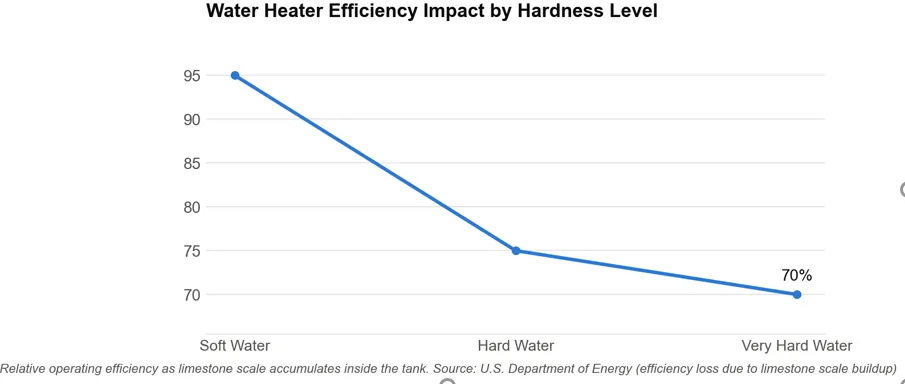
Scale acts as insulation, and that is the consequence people underestimate. The burner still fires and the element still pulls its full draw, but heat now has to cross a mineral layer before it reaches the water, so recovery time stretches. A tank that once brought a fresh 40 gallons up to temperature in half an hour starts needing 45 minutes, then most of an hour by the following summer. Meanwhile the utility bill drifts up by a few dollars a month, quietly enough that nobody thinks to blame the appliance. The efficiency penalty is not subtle once it is charted.
Hardness costs you a second component too. Every tank carries what the trade calls a sacrificial anode, meaning a rod of reactive metal installed so it corrodes in place of the steel wall around it, and mineral-heavy water chews through one considerably faster. Pull the anode on a four year old tank here and it can already be down to bare wire. Nobody inspects a part they have never heard of, which is how a tank travels from noisy to leaking with no warning in between.
A Year By Year Service Rhythm That Works
Here is the cadence I keep in a notebook, and it is boring on purpose. Year one, flush the tank once and write down how long the discharge runs cloudy. Year two, flush again and compare that against what you wrote. If the second flush pushes out visibly more grit than the first, hardness is winning and the interval needs to tighten to every six months rather than every twelve. Year three is when a softener stops being a nice upgrade and starts being the cheaper choice, because softened water does not lay fresh scale on top of the old layer. Year four is the honest checkpoint, and any competent shop doing water heater services leander tx should be willing to tell you whether the tank is still worth maintaining or whether you are pouring labor into something already compromised. That second answer is the one actually worth paying for.
What the schedule feels like from inside the house is worth spelling out. In the first week after a proper flush, the noise drops away and hot water lasts noticeably longer, which surprises people who had written the tank off as old. By month three the pops usually creep back in on a hard supply, faint at first, and that is not a failed flush so much as the timeline behaving normally. At the one year mark, a tank on the schedule sounds roughly like it did twelve months earlier, while the unflushed one next door has moved on to a steady rumble at every heat-up. Inside of three years those two are no longer comparable machines.
The money side stays small until it does not. Say a professional flush with an inspection runs somewhere in the $150 to $250 range in this part of the metro, called once a year, and a softener install lands near $1,800 for a typical single-family system. Set that against swapping out a tank at year five instead of year eleven. My service log does not lie about which of those two patterns costs more.
Schedule The Flush Or Budget The Replacement
Picking the moment to start is easier than people make it. Regional water conditions shift with rainfall, and this spring brought a real change: the National Weather Service Austin/San Antonio logged April 2026 as the 21st coolest and 11th wettest April on record, delivering the first month of above-average rainfall since July 2025 and easing drought severity across Central Texas. What your own tap hardness does with that depends on where your utility draws from, so test rather than assume. The decision in front of you is simpler either way. Either the flush goes on the calendar and the tank gets its full run, or the replacement goes into next year’s budget, and a four year old unit that rumbles is early enough in that choice for the answer to still be cheap.