


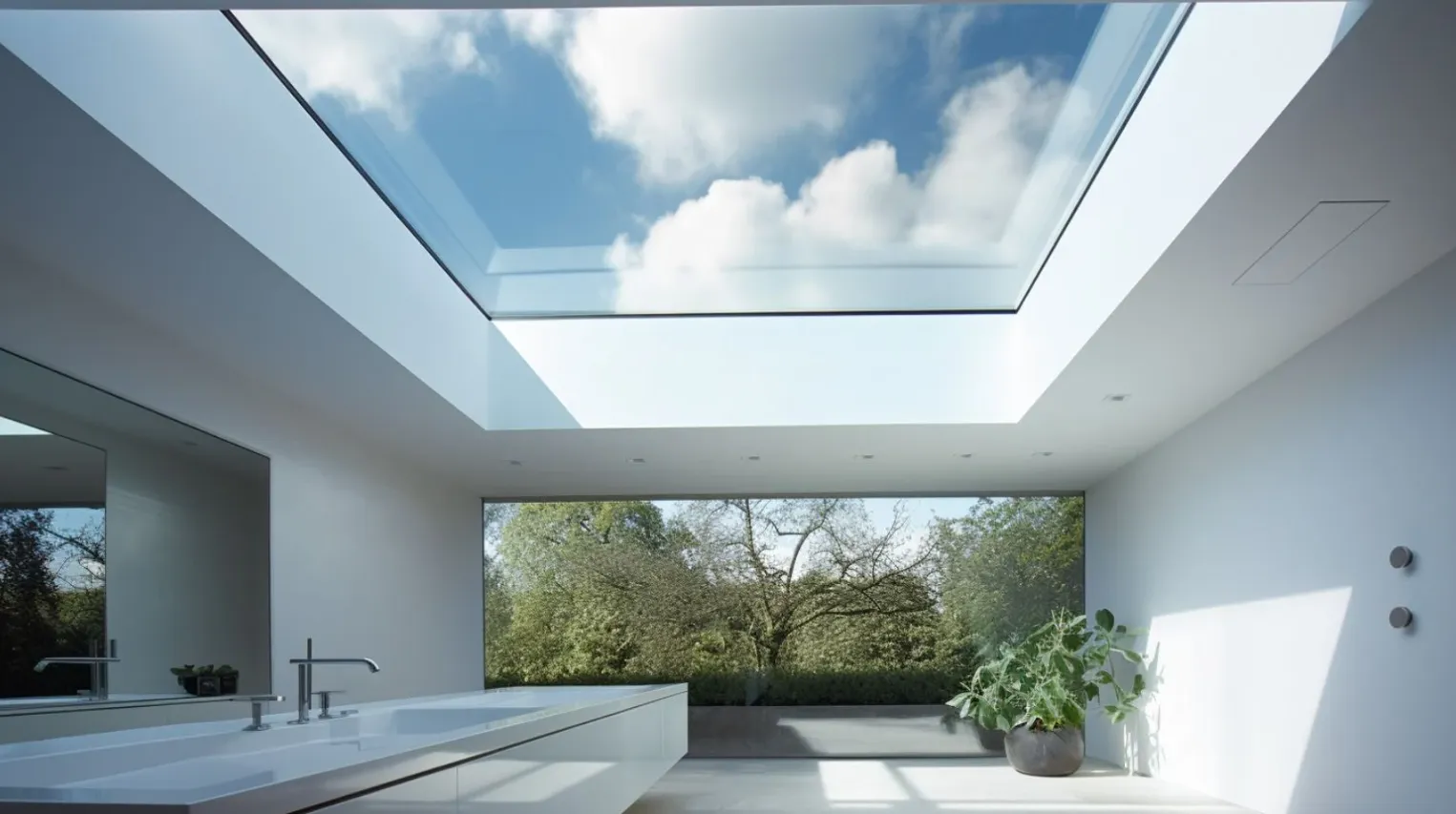
If two skylights have dripped every January since the house was built in 2003, the honest answer is usually to replace them or close them, not to reseal them a third time. Reseal wins by default because it is cheap, fast, and available this week. It also has a short memory. A pair of four-by-four curb-mounted units above a vaulted living room has spent more than twenty wet seasons flexing against a frame that expands and contracts on a different schedule than the glass sitting on top of it. So when the drywall below starts to bloom again, I stop calling general handyman crews and start looking for a local roofer poway ca who will work the curb, the flashing and the shaft instead of the pane. The decision gets simple once all three prices sit side by side.
Old Skylights Fail At The Curb, Not The Glass
The case we see most often is not a cracked pane at all. It is the curb, which is what roofers call the wooden box built up a few inches above the roof plane so the skylight sits proud of the water instead of down in it. That box has metal flashing wrapped around it, the flashing is nailed and sealed to the deck, and every one of those joints has a service life measured in years rather than decades. Water gets in at one corner, runs down inside the shaft, and shows up on the drywall several feet from where it started. Which is why the second reseal never held either: the bead went on top of a problem living underneath it. The stain spreading below the shaft is the receipt.
Reseal, Swap Or Close Up In Plain Words
Reseal means fresh sealant and sometimes new step flashing at the curb, with the unit and the opening left exactly where they are. A swap pulls the old skylight, rebuilds or re-flashes the curb, and sets a new unit with a factory flashing kit matched to your roofing material. Closing up is the option nobody offers unprompted: the skylight comes out, the hole is framed and decked to match the surrounding roof, insulated, and the ceiling below gets patched and textured. Different work, different crews, wildly different money.
Deciding between them requires someone on the roof, and that someone is not you. Skylight panels are not walkable, a twenty-year-old acrylic dome can give way under a knee with no warning at all, and a wet tile or shingle slope is a serious fall risk even for people who spend every working day on one. Researchers at CDC and NIOSH put ladders at the center of construction fall injuries, reporting that an estimated 81% of construction-worker fall injuries treated in emergency departments involve a ladder, alongside 113 ladder-related construction deaths in 2011. Stay off the roof and off the ladder. Let a crew with proper fall protection tell you what the curb actually looks like.
Putting Two Openings Through The Actual Numbers
Run the arithmetic as an example scenario rather than a quote, then swap in your own bids. Say a reseal runs $450 per skylight, so $900 for the pair, and it buys two dry winters. New units with rebuilt curb flashing land near $1,850 each installed, call it $3,700 for both. Closing both openings, framing and decking back to match the roof, runs roughly $1,400 apiece, or $2,800. Over eight years the reseal path repeats four times, $900 times four is $3,600, and a single drywall repair with texture and paint on a vaulted ceiling at $600 brings that to $4,200 all in, which is more than either permanent answer costs once.
What moves those figures most is access. A vaulted shaft means drywall, texture and paint on a ceiling nobody reaches from a step stool, and that interior trade shows up on the invoice whether the skylight stays or goes. Budget for it up front, or the closing option will feel like a bait and switch when the finish bid arrives.
Timing Against A Future Tear Off Changes Everything
The biggest lever here is how old the roof around the skylights is. If a tear-off is five years out, paying to rebuild two curbs now means paying for the same flashing work twice, because the new roof takes those curbs apart again. If the roof has fifteen years left in it, waiting is the expensive choice, since every wet month adds sheathing rot around the opening and more ceiling to repair. Reroof rules moved on you as well, since California’s updated Title 24 standards took effect in January 2026, and the Cool Roof Rating Council’s rundown of them puts the low-slope requirement at a minimum aged solar reflectance of 0.63 and an SRI of 75. That only bites if part of the house is low-slope, a rear addition or a covered porch, where the product list narrows and the bid shifts with it. Ask about the skylight decision and the roof timeline in one conversation.
When Closing The Opening Is The Honest Answer
Some openings should not be replaced at all. If a skylight sits near a valley, or lights a north slope that stays damp for days after a storm, or brightens a room that has since gained two solar tubes and a bank of recessed cans, the daylight is not worth the water risk it carries. Same story with a vaulted living room that already runs hot in August, which honestly gets me going about attic ventilation and radiant barriers, a completely separate argument about a completely separate failure. Back to the water. Removing the unit and decking the hole closed ends the leak permanently, and across ten years it is often the cheapest of the three. The catch is the ceiling, because you are trading daylight for a patch that a good finisher can hide and a rushed one cannot.
Decide Once And Stop Rebuying The Same Fix
Two leaking skylights and blooming drywall stopped being a maintenance item somewhere around the second reseal. Get all three prices in writing, reseal, swap and close, from a local roofer Poway CA homeowners have already used on a full tear-off, and ask each bid how long the fix is expected to hold. Compare those answers against the roof’s remaining life instead of against this month’s budget. Owners who do that stop watching the ceiling every January.