



Construction is a competitive business. Many firms are trying to stand out, earn trust, and win profitable jobs. Video helps because it shows your work in a clear, real way. It lets you explain your experience, prove what you can do, and connect with potential clients better than photos or text alone.
With video, construction companies can show projects in action, highlight careful workmanship and strong safety habits, and put real people behind the brand. This can help improve bid results and set a company apart from others in the same market.
If you’re interested in learning more about the subject, check out https://builtfor.studio/services/professional-video-and-photography-services/.
What Is Video Marketing for Construction Firms?
Video marketing for construction firms means using recorded video to promote your projects, services, and reputation. It is more than basic advertising. The goal is to build trust, make your brand easy to recognize, and attract better-fit clients. This can include project walkthroughs, site progress updates, case study videos, and short clips for social media. The main purpose is to show your quality, safety focus, and overall skill in a way that makes sense to decision-makers.
Why Are Construction Firms Adopting Video Marketing?
Construction marketing is different from many other industries. Projects can take months or years, job sites can be active and hard to explain, and clients judge you by results-not promises. For a long time, referrals were the main way to get work. Referrals still matter, but many clients now expect a strong online presence, especially Millennials and Gen Z who often search online before they call anyone. Cisco has predicted that about 80% of global internet traffic will be video, which makes video a must-have format for companies that want to show their work, win new bids, and keep people updated.
Video works well in construction because people like watching change happen. It is satisfying to see an empty site turn into a finished building, or an old space become modern and new. Video captures the scale and small details of a project in a way that text and photos can’t match. In busy markets (like Vancouver, where many firms compete), video helps companies get noticed and reach clients who might never see them through older marketing methods.
How Does Video Marketing Differ from Other Marketing Tactics in Construction?
Compared to brochures or long proposals that may never be read, video feels active and easier to follow. It can create an emotional connection and hold attention quickly. If text describes a hard engineering task, video can show it happening-steel going into place, a concrete pour, or crews working through a key stage. This visual proof builds trust faster than written claims.
Video also shares a lot of information in a short time and can push people to take the next step. Viewers are 95% more likely to remember a call to action after watching a video, compared to only 10% when reading it. Because video shows real people, real sites, and real processes, it helps build relationships, support your expertise, and prove your workmanship instead of just talking about it.
What Are the Benefits of Video Marketing for Construction Firms?
Adding video to a construction marketing plan can pay off in several ways. It is not just a “nice extra.” It can help you win bids, build a stronger brand, and even hire better people.
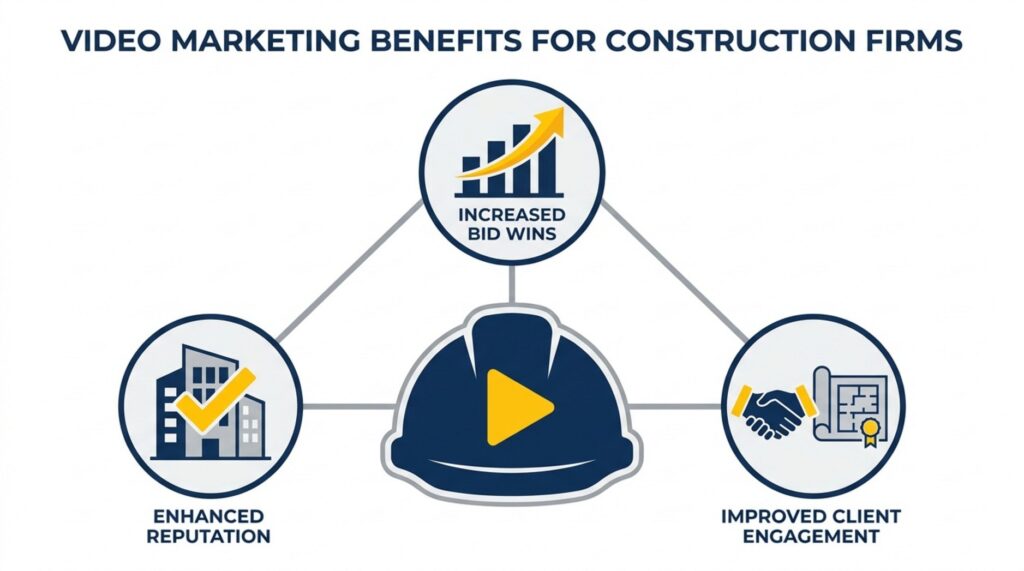
Increases Bid Acceptance Rates
One of the biggest benefits is better bid results. Studies show video presentations can raise proposal acceptance rates by up to 41% compared to text-only submissions, and some research shows win rates can rise by up to 30% when companies use video in proposals. The reason is simple: video shows proof. For large projects where clients are making big investments, seeing your work, your process, and your attention to detail can make the decision easier. Video proposals can include drone clips of finished buildings, time-lapse footage of complex builds, and 3D visuals that show what a future project will look like.
Stands Out from Competitors
In a crowded industry, being different matters. Clear, memorable video makes a company look modern and professional. Most clients do not care about “flashy” production as much as they care about real proof that you are reliable and skilled. In many cases, a simple video showing real work can do better than a polished promo that feels generic. By showing your specialties, equipment, and quality focus, video can help you build a clear place in the market and be seen as a leader in the type of work you do.
Builds Brand Awareness and Reputation
Video is a strong tool for brand awareness and reputation. Wyzowl reports that 95% of marketers say video has helped increase brand awareness. Video can show your values-like safety, reliability, and new ideas-while helping viewers feel connected. This makes it easier for people to remember your company when they need a contractor. Also, websites with video are 53 times more likely to rank on the first page of Google, which can improve visibility and support a stronger online reputation.
Improves Client Engagement and Retention
Clients who feel involved tend to be more satisfied, and satisfied clients often come back. Video helps keep people interested and can increase how long they stay on your website. Videos that show your culture, introduce your team, or give behind-the-scenes views help clients feel like they know you. That comfort can help them choose you. Videos can also teach clients about the construction process, answer common questions, and build long-term relationships so your company is the first one they call for the next job.
How Video Content Helps Construction Firms Win Projects
Video can help win work in several direct ways. It supports different parts of the client decision process, from early research to final selection.
Video Proposals and Virtual Statements of Qualifications (SOQ)
Written proposals alone do not stand out like they used to. Many firms now add video proposals and Virtual Statements of Qualifications (SOQs). A bid can include drone footage of finished work, time-lapse clips showing a full build from start to finish, and 3D visuals to show a future design in detail. Virtual SOQs with good audio and video let firms show how they build, walk through past projects, explain how they solved problems, and introduce leaders and project managers. This approach can be used even when in-person meetings are limited. It makes proposals easier to remember and more convincing.
Showcasing Completed Projects and Capabilities
Project showcase videos are one of the clearest ways to prove what you can do. Many are one to three minutes long and show a finished project from different angles. They often include music and short text on screen to point out key details or challenges solved. Firms also use walkthrough and progress videos to show quality, safety, and skill during the build-not just at the end. Process and capability videos can explain methods, show special equipment, or walk through quality checks. This helps clients understand what they are paying for and positions the firm as knowledgeable and dependable.
Demonstrating Safety Practices and Quality Controls
Safety is a major issue in construction, and showing your safety habits can help you stand out. Video lets you explain safety rules in a clearer way than a manual. Companies can record safety meetings, PPE use, and site rules in action. This helps reassure clients that you take worker safety and project protection seriously. The same is true for quality control: videos can show inspections, key checkpoints, and finishing standards, which helps prove you aim for strong work and fewer mistakes.
Presenting Client Testimonials and Social Proof
Hearing from real clients is one of the fastest ways to build trust. Testimonial videos let satisfied clients explain their experience in their own words. The best ones feel natural, not scripted. Clients can share what they worried about, why they chose your company, and what results they got. Video captures tone and emotion, which often feels more believable than a written quote. Simple questions can help, such as:
- “What was your biggest concern before we started?”
- “What made you choose our team?”
- “How did we handle problems as they came up?”
Building Trust with Prospective Clients
Most projects are won through trust. Video helps by showing the people behind the work. Team and culture videos can include quick introductions, safety training clips, or parts of company events. This shows that capable, approachable professionals will handle the job. This matters because construction projects are big investments. Many clients are more willing to hire a firm if they feel like they already know them, and video can create that familiarity in a way that static content can’t.
Types of Video Marketing Used by Construction Firms
Video is flexible, and construction firms can use several video types to meet different goals.
Project Showcase and Time-Lapse Videos
These are some of the most common and most effective formats. Project showcase videos highlight finished work in one to three minutes, showing different angles and key features. They often use music and short text to call out specs or key problems solved. Time-lapse videos compress months of work into 30 to 90 seconds. They are great for social media because they are easy to watch, often replayed, and frequently shared. Research shows time-lapse builds help prospects understand what a firm can do and build trust quickly.
Corporate Brand Story Videos
Brand story videos help explain who the company is. They often include company history, values, mission, past projects, and client success stories. The goal is to show what the company stands for-like safety, reliability, and new thinking-and help viewers feel confident about working with them. These videos can be used on a website, across social channels, and in client meetings.
Drone and Aerial Footage for Site Overviews
Drones give views that ground photos cannot. Aerial footage shows scale, progress, and building details from above. It can help in bids and marketing because it makes it easier to understand the full project site and the size of the work. Research also shows that drone footage, especially when used with time-lapse, helps prospects understand capabilities and builds trust fast.
Client Testimonial and Case Study Videos
Testimonial videos show real clients speaking about real results, which often feels more trustworthy than written reviews. Case study videos go deeper by covering:
- the client’s problem at the start
- the solution the firm used
- the final results
Both formats help with social proof and help clients feel more confident in their decision.
Presentation Screen Capture and Proposal Videos
For bids and formal presentations, screen capture and proposal videos are becoming more common. Virtual SOQs can combine clear audio, video, and visuals to show how your team builds, walk through past work, and introduce key leaders. Firms can also reuse material from internal presentations by turning it into webinars or short clips for social media. This makes slide decks more interesting and easier for clients to follow.
How to Create an Effective Video Marketing Strategy in Construction
Good videos matter, but a clear plan matters just as much. A strategy helps your videos stay focused and produce real business results.
Setting Clear Marketing Objectives
Before filming, decide what each video is for. Posting random clips once in a while usually won’t help much. Common goals include:
- Recruiting skilled workers
- Showing off a completed project
- Building long-term brand visibility
It also helps to name your audience. Are you speaking to commercial developers, homeowners, industrial managers, or city decision-makers? Each group cares about different things. Clear goals make it easier to plan the message, choose the right footage, and track results.
Selecting the Right Video Types for Target Audiences
Once you know your goals and audience, the right video formats are easier to pick. A time-lapse of a commercial build does a different job than a testimonial or a safety demo. Homeowners may connect more with before-and-after videos or “day in the life” crew content. Business clients may prefer Virtual SOQs or process videos that show special skills. A content calendar also helps keep output steady. Regular posting keeps your company visible instead of having one big push and then months of silence.
Optimizing Videos for Digital Platforms and SEO
Even great videos won’t help if people can’t find them. Basic SEO steps include using clear titles, descriptions, and tags with keywords clients search for (like “commercial construction time-lapse” or “office renovation before and after”). Captions matter too, since many people watch without sound on social platforms. Also match the video shape to the platform:
| Platform | Common best format |
| Instagram / Facebook | Square or vertical |
| YouTube / Website | Horizontal |
| Horizontal or square (depends on placement) |
Sharing videos across your website, YouTube, LinkedIn, Facebook, and email helps you reach different audiences at different stages.
Measuring Performance and ROI of Video Campaigns
To know what works, track results. Useful metrics include views, watch time, likes, comments, shares, and actions like website visits, inquiries, and quote requests. Identify which videos bring real leads and which ones fall flat, then adjust future content. Many marketers (93%) report strong ROI from video. Video can also help search by improving time-on-page and making content clearer for Google and AI tools when paired with clear headings and schema markup.
Best Practices for Construction Video Production
You don’t need a movie-level budget to create strong construction videos. Good planning and a few smart choices can raise quality quickly.
Investing in Professional Equipment or Services
Many firms can start with a smartphone, since modern phones record strong video. A few simple tools can help right away:
- Tripod: often under $50, adds stability and makes footage look more professional
- Gimbal: helps smooth movement for walk-through shots
- Microphone: audio matters a lot; a lav mic or shotgun mic improves clarity
For higher-stakes bids or brand videos, professional services can be worth it. Pros bring better cameras, drones, lighting, editing, sound, music, and voiceovers, which can support a message of quality and reliability.
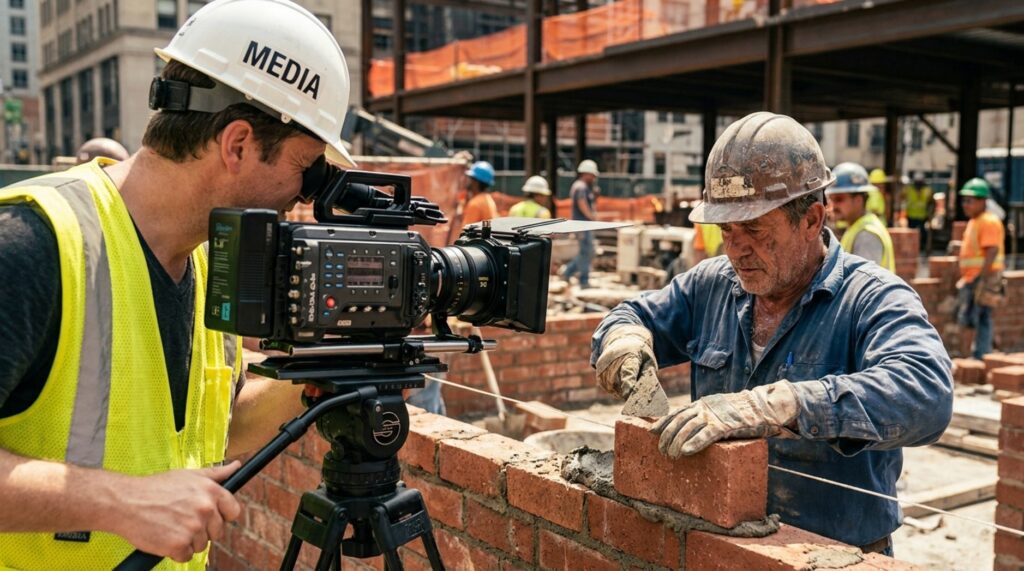
Capturing Compelling Footage On-Site
Good videos start with good raw footage. Try to record a mix of shots:
- Wide shots: show the full site and scale
- Medium shots: show crews working, equipment moving, materials being installed
- Close-ups: show craftsmanship and detail (tile lines, welds, finishes)
Film from different angles to keep the final edit interesting. Record more than you think you need. A 5:1 (or even 10:1) shooting ratio is common because it’s easier to cut extra footage than to fix missing shots later.
Editing Videos for Maximum Impact
Editing turns clips into a clear story. The first three to five seconds matter most, so start with your strongest moment (a dramatic before/after, a strong drone shot, or a great client quote). Keep the pace moving by changing shots every three to five seconds. Use music to set the tone, but don’t let it overpower spoken parts. Add text on screen only when it helps (project size, dates, key specs). Use light branding (logo, brand colors) and end with a clear next step, like visiting your website or requesting a quote.
Ensuring Safety and Compliance When Filming
Construction sites have real risks, so safety rules apply during filming too. Set access rules before filming starts. Make sure everyone on site, including the film crew, wears the right PPE and understands hazards. Drone filming must follow aviation rules and site safety plans. Licensed operators and proper planning help avoid problems with active work. Showing safe filming practices also supports your company image as responsible and professional.
Frequently Asked Questions About Construction Video Marketing
How Often Should Construction Firms Publish Video Content?
The right schedule depends on how many projects you have, your goals, and your available time and budget. Many construction companies do well with monthly or quarterly videos. A steady schedule matters more than occasional bursts. One strong video every quarter is usually better than ten videos in one month followed by six months of silence.
Which Types of Videos Are Most Effective for Winning Bids?
The best videos for bids are the ones that show clear proof of quality and capability, such as:
- Project showcase videos
- Time-lapse build videos
- Drone site overviews
- Virtual SOQs with team introductions and project walkthroughs
- Client testimonial videos
Are Drone and Aerial Videos Worth the Investment?
Yes. Drone footage shows scale, progress, and details that are hard to capture from the ground. For bids, it helps clients understand the full scope of your work. For marketing, it grabs attention quickly and supports a modern, capable image. Research shows professional drone footage helps prospects understand capabilities and build trust quickly.
What Is the Average Cost of Professional Video Production?
Costs vary widely, often starting at a few thousand dollars and going up depending on length, complexity (like animation, drones, multiple locations), and the level of production. Video does not always mean “expensive,” and there are more budget options now than in the past. A strong video often pays for itself through more bid wins, a better reputation, and improved hiring.
Does Video Marketing Help with Google and AI Search Rankings?
Yes. Websites with video are 53 times more likely to reach the first page of Google. Video can increase time-on-page, which signals value to search engines. Well-organized pages with clear headings and schema markup can also help with AI-generated summaries. Using relevant keywords in video titles and descriptions makes it easier for clients to find your services.
Key Takeaways for Construction Firms Using Video Marketing
As construction marketing becomes more digital, video is no longer just an extra. It is a practical growth tool. Construction is visual by nature, and clients and job seekers want to see real results, understand company culture, and feel confident before they make big decisions. Video gives that clarity and can help firms win bids, build a stronger brand, and attract skilled workers.
Video marketing is also more accessible than many people think. Affordable tools, freelancers, and specialized agencies make it possible for firms of any size to create useful content. One planned filming day can produce many pieces for different uses: website content, LinkedIn clips, tender presentations, and internal marketing. If your company hasn’t started using video yet, now is a good time. Strong, useful videos can improve visibility, bring more website traffic, and build the long-term trust that supports steady business growth.